Cohasset
Mariners' Museum, Uncurated Search Results
Type: Schooner
Year:
Builder:
Location:
These records are found in the online catalog of The Mariners’ Museum and Park in Newport News, Virginia. Uncurated search results are presented to give researchers and interested readers an idea of whether the museum’s archives contain information about this vessel and whether it may be worthwhile to visit the museum’s catalog search page for further investigation. Uncurated results may be inaccurate or incomplete.
Search mode: Exact Name. Search phrase(s): "Cohasset". Results returned: 24. Results displayed in this table: 24.
Use these buttons to send uncurated search results to your own app or text document for further research. First, check the box for any row, or click "Select All" then uncheck any rows. Then click "Show Selections". You can then copy your selections from the text box and past them into your app.
| Fetch? | Row ID | Media | Date | Vessel | Place | Related Places | Inscription/Marks | Subject | Notes | Archive Number |
|---|---|---|---|---|---|---|---|---|---|---|
| 1 | 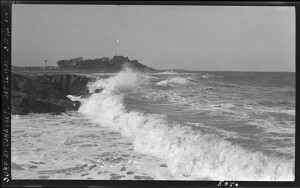 | 10/26/1930 | Cohasset (Mass.). | Surf at Cohasset. Oct 26. 1930. f11 1/100. 100'. / 5056. | Bays–Massachusetts–Cohasset.; Ocean waves–Massachusetts–Cohasset.; Beaches–Massachusetts–Cohasset. | Looking out to sea from the shore, shows the surf on a rocky beach. | P0006/02.02-03.09#02 | |||
| 2 | No image URL. | Minot's Ledge Lighthouse (Mass.). | Lighthouses–Massachusetts. | Minot's Ledge Light : __solitary sentinel of Cohasset. | LB106209 | |||||
| 3 | 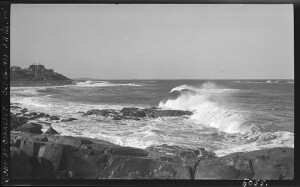 | 10/26/1930 | Cohasset (Mass.). | Surf at Cohasset. Oct 26. 1930. f11 1/100. 100'. / 5055. | Bays–Massachusetts–Cohasset.; Ocean waves–Massachusetts–Cohasset.; Beaches–Massachusetts–Cohasset. | Looking out to sea from the shore, shows the surf on a rocky beach. | P0006/02.02-03.09#01 | |||
| 4 | No image URL. | 1918-1919 | Caption: "Cohasset, Mass." | MS0003/-004.2544 | ||||||
| 5 | No image URL. | Winjammers of the present time and bygone days. . . illus. COHASSET (SCHOONER). | LB43450 | |||||||
| 6 | 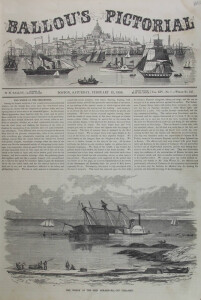 | NOTES: Published in Ballou's Pictorial, February 13, 1858, Volume XIV, No. 7. The image shows the ship Serampore, off Cohasset, Massachusetts, heeled over on her starboard side with the steamer Neptune alongside. VESSEL INFORMATION: VESSEL NAME: SERAMPORE SHIP BUILDER: TALBOT SHIPBUILDER LOCATION: BOSTON, MASSACHUSETTS SHIP OWERN: BRAS d'OR STEAM CO. | CL24144 | |||||||
| 7 | No image URL. | Massachusetts–Description and travel.; Massachusetts–Guidebooks; Newport (R.I.)–Description and travel; Newport (R.I.)–Guidebooks | Summer resorts–Massachusetts–Guidebooks. | "All the localities mentioned in the Guide are reached either by the Old Colony Railroad and its connections, or by the Boston & Nantasket Steamboat Line" P. [4]. Includes index. 3 folded maps inserted. | LB87315 | |||||
| 8 | 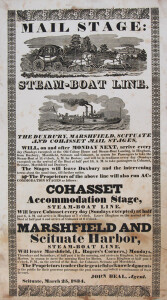 | VESSEL INFORMATION - VESSEL NAME: GENERAL LINCOLN SERVICE DATES: 1832-1949 SHIPBUILDER: J. BOND BUILDER LOCATION: PHILADELPHIA, PENNSYLVANIA SHIP OWNER: BOSTON & HIGNHAMM STEAMBOAT CO. | CL9765 | |||||||
| 9 | No image URL. | Anna R. Heidritter (Schooner); Cohasset (Schooner); Heidritter Lumber Co; Nordhavet (Steamship) | The four-masted schooner Anna R. Heidritter 1903-1942 : __a record of her last sixty-three voyages and attendant expenses __compiled by Robert H.I. Goddard | LB19533 | ||||||
| 10 | No image URL. | Massachusetts–Description and travel.; Massachusetts–Guidebooks; Newport (R.I.)–Description and travel; Newport (R.I.)–Guidebooks | Summer resorts–Massachusetts–Guidebooks. | "All the localities mentioned in the Guide are reached either by the N. Y., N. H. & H. R. R. and its connections, or by the Boston & Nantasket Steamboat Line" P. [4]. Includes index. 3 folded maps inserted. | LB87316 | |||||
| 11 | No image URL. | Massachusetts–Description and travel.; Newport (R.I.)–Description and travel | Summer resorts–Massachusetts–Guidebooks. | "All the localities mentioned in the Guide are reached either by the Old Colony Railroad and its connections, or by the Boston & Nantasket Steamboat Line." P. [4]. | LB37608 | |||||
| 12 | No image URL. | Massachusetts–Description and travel.; Massachusetts–Guidebooks; Newport (R.I.)–Description and travel; Newport (R.I.)–Guidebooks | Summer resorts–Massachusetts–Guidebooks. | "All the localities mentioned in the Guide are reached either by the Old Colony Railroad and its connections, or by the Boston & Nantasket Steamboat Line" P. [4]. Includes index. 3 folded maps inserted. | LB87314 | |||||
| 13 | 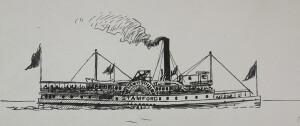 | VESSEL INFORMATION - VESSEL NAME: STAMFORD VESSEL TYPE: AMERICAN WOODEN SIDEWHEEL STEAMER VESSEL BUILT: 1863 SERVICE DATES: 1863-1900 SHIPBUILDER LOCATION: BROOKLYN, NEW YORK VESSEL DIMENSIONS: 168'8" L x 28'1" B x 8'2" depth of hold, gross tonnage 483.36 VESSEL HISTORY: She was used for a few years on the New York and Bridgeport Service, later to Sag Harbor. During the 70's she ran from Boston to Gloucester and later to Plymouth in which service she remained for most twenty years. She was renamed JOHN ENDICOTT about 1895 and during the season of 1896 plied between Boston and Salem Willows for the Morrison Steamboat Company. She was lost in September 1900 while attempting to make a short cut over Cohasset Rocks. She was then under the command of Captain E W Davidson. | CL22608 | |||||||
| 14 | 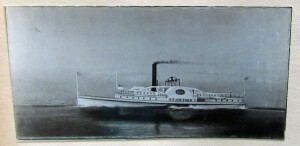 | SHORT DESCRIPTION: Painted on canvas, mounted on stretcher. VESSEL INFORMATION - VESSEL NAME: STAMFORD VESSEL TYPE: AMERICAN WOODEN SIDE-WHEEL STEAMBOAT VESSEL BUILT: 1863 SERVICE DATES: 1863-1900 SHIPBUILDER LOCATION: BROOKLYN, NEW YORK VESSEL DIMENSIONS: 168'8" L x 28'1" B x 8'2" depth of hold, gross tonnage 483.36 VESSEL HISTORY: She was used for a few years on the New York and Bridgeport Service, later to Sag Harbor. During the 70's she ran from Boston to Gloucester and later to Plymouth in which service she remained for most twenty years. She was renamed JOHN ENDICOTT about 1895 and during the season of 1896 plied between Boston and Salem Willows for the Morrison Steamboat Company. She was lost in September 1900 while attempting to make a short cut over Cohasset Rocks. She was then under the command of Captain E W Davidson. Alternate vessel names: (1) STAMFORD (1863-1895); (2) JOHN ENDICOTT (1895-1900). | CL11569 | |||||||
| 15 | 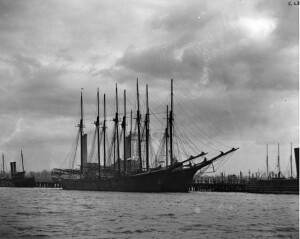 | WRITTEN ON VERSO: EX. COHASSET, BUILT 1903, AT BATH, MAINE BY KELLEY SPEAR & COMPANY, REBUILT 1910, OWNED 1940 BY B.D. COLEMAN, MARYLAND, 694T, 185 X 37.1 X 13.5 | CURATOR NOTES: View of ship at dock. | P0001.011/01-#PK2220 | ||||||
| 16 | 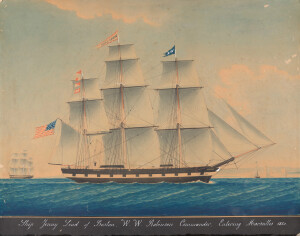 | LABEL COPY: SHIP JENNY LIND of Boston. W.W. Robinson, Commander, Entering Marseilles, 1850 Honore Pellegrini (French, 1793-1869) Watercolor Museum Collection, QW 789 In 1848, Boston shipwirght Donald Mckay (1810-1880) built JENNY LIND, one of many vessels so named. In contrast to the figurehead on display, the vessel depicted here carried a full-length representation of the SWEDISH NIGHTINGALE. The Boston, JENNY LIND carried cotton between New Orleans and Liverpool, England. In 1850, the ship traveled to France, where Pellegrini painted this portrait. (Shipcarver 96/7 ) DISPLAY CARD: Packet ship, one of the early vessels built by Donald McKay, East Boston, Massachusetts. She was launched in May 1848, for Fairbanks and Wheeler, Boston merchants engaged in the cotton trade, and was McKay's first "cotton carrier." During the cotton season her voyages generally were from Boston to New Orleans to Liverpool and return to Boston. Doubtless she delivered cotton to Boston also, as evidenced by her going ashore at Cohasset, Mass., February 18, 1849, with 1885 bales aboard; she was little damaged. From this picture, it is evident that she went to the Mediterranean as well as Liverpool. (Length141 feet, 532 tons). | CL5229 | |||||||
| 17 | 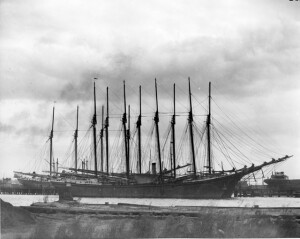 | WRITTEN ON VERSO: EX. COHASSET, BUILT 1903, AT BATH, MAINE BY KELLEY SPEAR & COMPANY, REBUILT 1910, OWNED 1940 BY B.D. COLEMAN, MARYLAND, 694T, 185 X 37.1 X 13.5 | CURATOR NOTES: View of ship at dock. | P0001.011/01-#PK2219 | ||||||
| 18 | 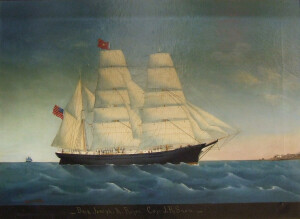 | SHORT DESCRIPTION: Oil painting on canvas by Hammond titled 'Bark Joseph A. Ropes, Capt. J. R. Snow'. The image shows a starboard broadside view of the American three masted bark under full sail. Flying a red flag with yellow ball on the main mast. In the background at the right is a headland. In the background at the left is another ship under full sail. VESSEL INFORMATION - VESSEL NAME: JOSEPH A. ROPES SERVICE DATES: 1877-1893 VESSEL BUILT: 1877 VESSEL TYPE: BARK OFFICIAL NO. 75987 SHIPBUILDER: NATHANIEL PORTER KEEN BUILDER LOCATION: WEYMOUTH, MASSACHUSETTS SHIP OWNERS: JOSEPH A. ROPES HOME PORT: Boston (1877-1881), New York (1881- ) SHIP CAPTAIN: J.R. SNOW (1877-1881), PAINE (1881-1883), S. W. SEABURY (1883-1887, 1893), TERWELEGAN/TERWILLIGER (1888), SMITH (1889-1890), EMERY (1890-1891), LAWRENCE (1891-1892) VESSEL DIMENSIONS: 152'3" x 37'2" x 19'2", gross tons 711; net 680 FATE: Ashore at Madagascar July 4, 1893. VESSEL HISTORY: [compiled by Jeanne Willoz-Egnor, May 1, 2024] --New York Daily Herald, November 24, 1877, page 10, reports: the bark Joseph A. Ropes, of 750 tons, built by Mr. Porter Kean at Quincy, stuck on the ways 21st. She is intended for the Zanzibar trade with Boston, and will be commanded by Capt. Snow, formerly of the bark Sicilian. --Boston Post, May 1, 1878, page 4, reports: Arrived at Tamatave previous to 5th ult, bark Joseph A. Ropes, Snow, Boston. --Boston Post, July 15, 1878, page 4, reports: Arrived at Zanzibar May 15. Sailed 24th for Muscat. --Boston Post, July 22, 1878, page 4, reports: Arrived at Aden 14th ultimate. --Boston Post, August 2, 1878, page 4, reports: At Aden June 20th. --Boston Post, October 22, 1878, page 4, reports: At Muscat 20th ult. loading for New York. --New York Daily Herald, January 3, 1879, page 10, reports: Muscat, December 18, barks Joseph A. Ropes, Snow, New York. --Boston Post, November 18, 1879, page 4, reports: Sailed from Tamatave, September 15, Joseph A. Ropes, Snow, Mauritius. --Boston Post, December 13, 1879, page 6, reports: Arrived at Aden prior to November 29, from Mauritius. To sail December 12 for Muscat. --New York Times, May 1, 1880, page 8, reports: Muscat, April 6, sailed bark Joseph A. Ropes, Capt. Snow, for New York. --New York Times, August 21, 1880, page 8, reports: Bark Joseph A. Ropes, Snow, Muscat, 135 days with merchandise to George Ropes. --Liverpool Mercury, August 24, 1880, page 7, reports: Arrived New York August 22, Joseph A. Ropes, from Muscat. --The Portland Daily Press, January 28, 1881, page 3, reports: Arrived at Bombay 26th instant, barque Joseph A. Ropes, Snow, New York. --Boston Evening Transcript, March 9, 1881, page 7, reports: At Bombay, February 5, barque Joseph A. Ropes for Muscat. --Boston Evening Transcript, March 12, 1881, page 7, reports: Arrived at Muscat March 2, barque Joseph A. Ropes, Snow, from Bombay. --New York Times, August 6, 1881, page 8, reports: Arrived bark Joseph A. Ropes, Snow, Muscat, March 19, Tamatave May 13, with merchandise to J. H. Goldsmith. --Boston Post, August 8, 1881, page 4, reports: William E. Rogers, steward of the bark Joseph A. Ropes, Snow, now of New York, died March 24 and was buried at sea. --New York Times, August 29, 1881, page 8, reports: Sailed bark Joseph A. Ropes, for Zanzibar. --Boston Evening Transcript, January 21, 1881, page 8, reports: Sailed from Zanzibar previous to 25th, barque Joseph A. Ropes, Paine, New York via Madagascar. --New York Times, May 26, 1882, page 8, reports: Bark Joseph A. Ropes, Paine, Madagascar, 71 days, with hides and cloves to George H. Ropes, vessel to J. H. Goldsmith. --Glasgow Herald, April 4, 1883, page 8, reports: Joseph A. Ropes, from Majunga at New York (by cable). --Boston Evening Transcript, August 29, 1883, page 7, reports: Arrived at Mauritius August 11, barque Joseph A. Ropes, Seabury, New York for Zanzibar. --Philadelphia Inquirer, May 21, 1884, page 8, reports: Lewes, Delawar, May 20, tug Pride reports: spoke nine AM, eight miles south of Five Fathom Light, bark Joseph A. Ropes, 73 days from Madagascar, for New York. --Boston Evening Transcript, June 20, 1884, page 7, reports: Sailed 19th, New York, for Zanzibar. --Boston Evening Transcript, October 29, 1884, page 7, reports: Arrived at Aden 27th, barque Joseph A. Ropes, Seabury, New York via Zanzibar. --Boston Evening Transcript, December 6, 1884, page 11, reports: Sailed from Aden November 7 for Muscat. --The Boston Globe, June 14, 1885, page 7, reports: Barks Joseph A. Ropes, Seabury, New York, G. Ropes. Sailed June 15. Cleared 29th for Zanzibar (Boston Evening Transcript, June 30). --Evening Express, October 5, 1885, page 4, reports: Spoken Joseph A. Ropes, for Zanzibar, August 22, 5S,25W. --The New York Times, December 17, 1885, page 8, reports: The bark Joseph A. Ropes (Amer.) Captain Seabury, at Mauritius, from New York, is leaky, her stem having been damaged. She will discharge and repair. --The Galveston Daily News, January 12, 1886, page 8, reports: Waking up a Whale. Edwin F. Lawrence, now first officer of the bark Joseph A. Ropes, but well known in Galveston, having sailed in and out of this port for years, writes to a friend in Yarmouth, Mass., and the letter is reprinted in the Cape Cod Item, of January 1. The letter is dated at sea, October 25, 1885, and says: "On the 7th of October, in latitude 32 38' south, and longitude 46 40' east. while on the passage from New York to Madagascar, while running at the rate of ten and a half miles an hour, we experienced a very heavy shock, as if we had struck something very heavy. Immediately forward a large sperm whale was seen alongside, rolling over and over, around which the water was very much discolored with blood. He managed to gather himself up when we had got a ship's length ahead of him. On looking over the ship we found the cut-water knocked one side from the lower bobstay almost down to the shoe, and the copper torn off quite badly at the lower bobstay. The ship has been leaking from 600 to 800 strokes an hour since." --The Republican Journal, March 11, 1886, page 3, reports: Mauritius, January 24th sailed bark Joseph A. Ropes, Seabury, Manooroo. --The Republican Journal, April 22, 1886, page 3, reports: Zanzibar, sailed March 25th for Boston. --Boston Evening Transcript, May 21, 1886, page 5, reports: Sailed from Nossi Be for Boston via Marnterano. --The Daily Item, August 30, 1886, page 1, reports: ASHORE OFF COHASSET. Serious Charges Against the Keepers of Minot's Light. During the dense fog that hung over the lower Boston bay during Sunday morning, the large bark Joseph A. Ropes, of New York, Capt. Seabury. 101 days from Madagascar, with a cargo of hides consigned to Boston parties, ran ashore on the "Grampuses." Capt. Seabury states that he lost his bearings in the fog, and therefore made short tacks off and on shore. As he supposed by compass, making frequent soundings. His last sounding showed about eighteen fathoms. The fog was so dense that he could hardly see his vessel's length, and the strong flood tide drifted him considerably, and shortly after making his last sounding he felt the vessel touch gently on the bot tom, scrape along a few seconds and then come to a dead stop. He sounded his pumps and found that the vessel was making no water and was apparently uninjured. The fog soon after lifted and the captain found himself directly in the midst of Cohasset Rocks high and dry on the "Grampuses," a shoal, rocky bottom, about two miles southwest of Minot's Ledge and one mile from the Cohasset shore. Captain Seabury makes a serious charge against the keepers of the Minot's Ledge Lighthouse, stating that during all the time that he was in close proximity to the structure not a blow was struck on the fog bell, which the department regulations order struck continually during foggy weather. This charge is corroborated by every member of the crew. The case will probably be reported to the Lighthouse Depot at Washington. --The New York Times, August 30, 1886, page 1, reports: A NEW-YORK BARK ASHORE. BOSTON, Aug. 29. The bark Joseph A. Ropes, of New-York, Capt. S. W. Seabury, 101 days from Madagascar, went ashore today inside of Minot's Ledge Light, off the Cohasset shore. For two days the Captain reports she had been in Massachusetts Bay in a thick fog without seeing a pilot. This morning she made Boston Light and while standing off with all canvas set, was drifted by the tide on to the ledge. She stuck fast, and as the tide was ebb she was left at low water nearly high and dry, but resting on a fairly even keel. Fortunately there was little sea and examination revealed but little apparent damage. The tug Confidence went from this port to her assistance, and it is thought she can be got off at high water. --The Boston Globe, August 30, 1886, page 8, reports: TOW THE ROPES TO BOSTON. Three Tugs Succeed in Getting the Bark Off the Grampuses. COHASSET. Mass, August 30. The bark Joseph A. Ropes, which grounded on the Grampuses yesterday morning, was towed partly over the ledge by the tug Confidence at 11 o'clock last night. The tugs Confidence, Storm King, and a smaller one whose name could not be made out from the shore, floated her this morning at 8:30, and towed her to Boston. She is apparently & uninjured. --The Daily Item, August 31, 1886, page 3, reports: THE JOSEPH A. ROPES. An Unfortunate Voyage, The Mate's Account of the Latest Disaster. The bark Joseph A. Ropes, which went ashore on the "Grampuses," Sunday, was pulled off by the tug Confidence and towed to a berth at the Eastern Railroad dock, at East Boston, arriving there at 11:30 o'clock Monday forenoon. The bark left Marnterano, Madagascar, May 20, with a cargo of hides consigned to George Ropes, Boston. The whole voyage of 14 months has been singularly unfortunate, the log showing one long record of accidents, sickness and death. On the passage out the vessel struck a whale with such force as to start the cutwater and badly damage the stem. From the effects of this accident the craft made water, at the rate of eighty strokes per hour, until her arrival at Madagascar, three weeks later. The following story of her grounding, Sunday, is given by the first officer, E. F. Lawrence, of Falmouth: "We came across Nantucket Shoals, Friday night." he said, "in a thick fog, and did not see or bear any other craft, but were keeping our own fog horn blowing. Saturday night we sighted Thatcher's Island lights just as they were lighted, and we then tacked to the south'ard to keep off shore. We then steered for Boston light by compass, keeping the lead going and tacking off the South Shore, when we found the water shoaling. Early Sunday morning, on one of the tacks inshore, the lead suddenly gave only six fathoms, and we thought best to anchor. I ordered the anchor let go, but found the chain would not run out, and on looking over the bow saw a big rock ahead, on which the ship had grounded so lightly as not to be felt. This was about high water, and by backing the topsails she floated off into deeper water and swung to her anchor. At low tide, however, we were aground and listed about eight streaks to starboard, but she lay quietly, and there was no sea on to make her grind or bump. The tug came alongside later in the day, and we were visited by about all the people in Cohasset, I should think. Monday morning we were afloat before high tide high tide and were towed up to the city, not having received a particle of damage. The bark is as sound and tight as she ever was." --Boston Evening Transcript, October 5, 1886, page 6, reports: Cleared yesterday, bark Joseph A. Ropes, Seabury, Zanzibar and a market, by George Ropes. --Boston Post, May 13, 1887, page 3, reports: Mauritius, in port April 8, bark Joseph A. Ropes, Seabury, from Tamatave. Sailed on the 14th. Arrived at Tamatave on May 19th from Mauritius. --Boston Evening Transcript, November 21, 1887, page 7, reports: Death of Three of a Barque's Crew. The barque Joseph A. Ropes of New York arrived at this port yesterday from Majunga, from which port she sailed Aug. 2. In the passage two of the crew, Theodore Jackson, forty-five years old, belonging in Boston, and Fred Krowse, twenty-eight years old, died of coast fever. They were buried at sea. On July 7, while the barque was lying in the port of Nossi-Bé, the first officer, Stillman C. Jones, a native of Salem, Mass,, died from the bite of a scorpion. The mate was bitten while lying in his berth, in which the scorpion was hidden. Mr. Jones left a widow, who lives in East Boston. Captain Seabury and one of his crew are now sick with the coast fever. --Boston Evening Transcript, December 19, 1888, page 12, reports: Mauritius, In port December 10, barque Joseph A. Ropes, Terwelegan, from Reunion. --The Boston Globe, March 4, 1888, page 8, reports: Bark Joseph A. Ropes, Terwilliger, sailed from Zanzibar for Boston January 17. --The Boston Globe, July 10, 1889, page 1, reports: The bark Joseph A. Ropes is hauled out on the ways at Burnham's and will be caulked and recoppered. --The Boston Globe, July 26, 1889, page 3, reports: Bark Joseph A. Ropes, Smith, Bombay via New York, George Ropes. Towed by tug Joshua Lovett. Arrived New York same day. --The Portland Daily Press, February 26, 1890, page 3, reports: Arrived at Majunga January 11 from Tamatave. --The Boston Globe, April 11, 1890, page 3, reports: Bark Joseph A. Ropes, Emery, Majunga, 75 days, hides, George A. Ropes. Cleared Boston May 11 for Tamatave and a market, George Ropes. --The Boston Globe, December 29, 1890, page 3, reports: Bark Joseph A. Ropes of New York, Emery, Marjunga and Tamatave, Madagascar. --Boston Post, January 9, 1891, page 3, reports: Joseph A. Ropes, Emery, 711, George Ropes at National EB (shipyard). --Boston Evening Transcript, page 5, reports: Barque Joseph A. Ropes, Emery, Zanzibar and a market by George A. Ropes. --The Boston Globe, December 7, 1891, page 5, reports: Bark Joseph A. Ropes, Lawrence, Zanzibar, via Tamatave. Cleared Boston on 17th. --The Boston Globe, December 20, 1891, page 7, reports: tug International towing barges [sic] Joseph A. Ropes for New York. --Boston Post, September 13, 1892, page 7, reports: Tamatave (Madagascar), cleared July 29, bark Joseph A. Ropes for Boston. Reported at Boston on November 4th. --The Portland Daily Press, March 27, 1893, page 7, reports: New York, cleared 24th, Barque Joseph A. Ropes, Seabury, Gibraltar. --Glasgow Herald, July 17, 1893, page 8, reports: The American barque Joseph A. Ropes stranded at Tamatave on 4th July. Unsuccessful attempts have been made to get her off. She is settling in the sands and is full of water. Cargo being got out as rapidly as possible. She had part of her inward cargo on board. --Hartford Courant, July 26, 1893, page 8, reports: Essex, Ropes of Boston, proprietor of the ivory factory near the Valley Railroad depot, has recently lost the bark Joseph A. Ropes, engaged in the African trade. It was wrecked near the island of Madagascar while bound for Zanzibar after a cargo of ivory for New York. | CL20644 | |||||||
| 19 | 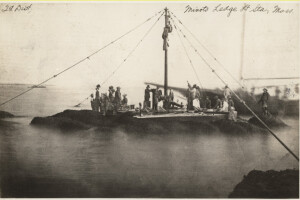 | 1859 | MASSACHUSETTS | WRITTEN ON VERSO: Laying foundation | CURATOR NOTES: Photograph shows workers laying foundation 1859. From 1851 to 1860 a lightship replaced the tower at Minot's Ledge. Work on the new stone tower began in 1855. The new Minot's Light was designed by General Joseph G. Totten of the Lighthouse Board, and it has been called the greatest achievement in American lighthouse engineering. Capt. Barton S. Alexander made some modifications in the design and was superintendent of the project. Because the construction could only take place at low tide on calm days, the cutting and assembling of the granite took place at Cohasset's Government Island, attached to the mainland. A team of oxen moved the blocks to a vessel that brought them to the ledge. Workers complete the first course of granite at Minot's Ledge The project had a setback in January 1857, when the iron framework that had been erected was destroyed during a storm. Captain Alexander was discouraged, saying, "If wrought iron won't stand it, I have my fears about a stone tower." He was relieved when it became apparent that the damage was caused by a ship that hit the ledge, not by the waves. The rocks themselves were damaged by the collision, and the work had to start all over again. On July 9, 1857, the first granite block was laid for the tower. Many times during the construction waves swept the workers off the rocks. A Cohasset diver, Captain Michael Neptune Brennock, was hired to act as a lifeguard. | P0001.012/01-#PL033 | ||||
| 20 | 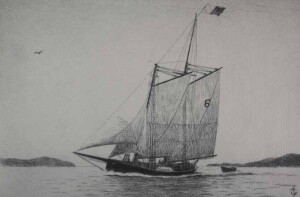 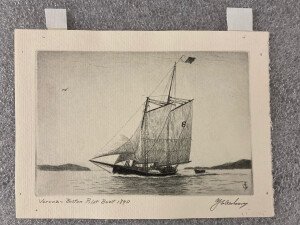 | NOTES: Charles J. A. Wilson was born in 1880 in Glasgow, Scotland. He came to America as an infant and in his teens moved to Newton, Massachusetts. Wilson was a prolific, self-taught, marine artist who gained much of his experience from working in the Boston shipyards. He worked as an artist for Bethlehem Shipbuilding in East Boston, etching their ships from blueprints. During the World War I, Wilson spent two years in France. After the war he was commissioned to paint and etch American ships and marine views. During World War II, Wilson worked in Boston as an official Coast Guard artist. He was a member of the Boston Society of Printmakers, and exhibited with Pennsylvania Academy of the Fine Arts, Society of American Etchers and the Currier Gallery. VESSEL INFORMATION - VESSEL NAME: VARUNA VESSEL DATE: 1890 VESSEL TYPE: PILOT BOAT DESIGNER: Edward Burgess SHIPBUILDER: Howard & Montgomery SHIPBUILDER LOCATION: CHELSEA, MASSACHUSETTS VESSEL DIMENSIONS: 91 TONS, GROSS, 87.9 x 23.3 x 9.7 REGISTERED: BOSTON, MASSACHUSETTS VESSEL HISTORY: Dropped by List of Merchant Vessels for 1914. Notes from Pilots and pilot boats of Boston Harbor : presenting stories and illustrations ...by Eastman, Ralph M., page 61: The Boston pilot boat Varune survived the famous Portland storm of November 26-27, 1898. During a long career in the piloting service, the most hazardous experience of the Varuna occurred the night of the “Portland” storm of November 26 and 27, 1898. When the storm broke she was about 20 miles off Minot’s Light, Cohasset. Captain William H. Fairfield had himself lashed to the wheel and remained on duty 24 hours, not allowing himself to be relieved until two of his ribs were broken from beating against the binnacle. The fore¬ sail was carried away and ice and snow added to the difficulties encountered. However, the Varuna survived the terrible ordeal by following the instructions given by Captain Fairfield as he was carried drenched and injured to his bunk: “Keep her headed up, make a straight wake; she is made of oak and copper and can stand it.” One of her two “yawls” was crushed and the other was damaged, her lee rail was carried away and the morning light revealed that her deck was completely covered with sand blown from sandbars when she was off Cape Cod during the night. Crippled as she was, she was still carrying on as a pilot boat should and, repairing her damaged “yawl” as well as possible, it was used to put a pilot aboard an incoming Philadelphia vessel which then towed the Varuna into port. | CL17247 | |||||||
| 21 | 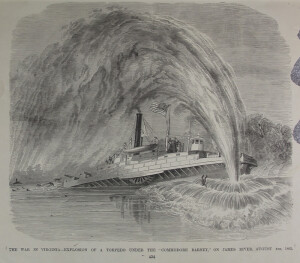 | SHORT DESCRIPTION: The print shows the steamboat, Commodore Barney, just as a torpedo has blown the ship out of the water of the James River on August 4, 1863. There is a man near the bow who is falling into the water, and another group of men at the stern who are falling in or swimming away. NOTES: From page 434 of “Frank Leslie’s Illustrated History of the Civil War,” published in 1895 by Mrs. Frank Leslie. Mrs. Leslie was originally Miriam Florence Folline, though she added Peacock, Squier, and Leslie after various marriages. She married Frank Leslie in 1874, but he died in 1880. She then legally changed her name to Frank Leslie in 1881, which is how this book came to be published by Mrs. Frank Leslie. The image first appeared in “Frank Leslie’s Illustrated Newspaper,” no. 415, volume XVI, published August 29, 1863 but it is not an exact match to the marks on this print. TEXT from 1863 publication: “A reconnaissance was made up James River, on the 4th of August, by the gunboats Com. Barney, Sangamon and Cohasset nearly up to Drury’s bluff. Brig.-Gen. H.M. Naglee, commander of the 7th army corps, was on board the John Faron and obtained much important information. Near Aiken’s landing they were annoyed by sharpshooters, but when within six miles of Fort Darling a torpedo exploded under the bow of the Barney. It must have been of immense force, as the steamer was lifted 10 feet out of the water, and swept by a jet of water which was hurled 50 feet in the air, and then fell with deluging effect on the deck, carrying 30 men overboard. These were all saved except two, but the Barney was too much disabled to proceed, and being taken in tow, the fleet dropped down. At Turkey island they were joined by the Gen. Jesup, and compelled to run the gauntlet of a severe artillery fire from the shore, Malvern Hill again resounding to the roar of artillery. Our sketch of the accident to the Barney may seem an exaggeration, but is attested by persons present as being literally and really accurate, as indeed are all the sketches we present, a fact which gives our paper a surpassing value as a record of the period.” VESSEL INFORMATION-- VESSEL NAME:COMMODORE BARNEY SHIP NUMBER: VESSEL TYPE: United States Gunboat SERVICE DATES: 1859-1902 DATE WRECKED: SHIP BUILDER:Thomas Stack SHIP LINE: BUILDER LOCATION:Williamsburg, New York ASSOCIATED PLACE: VESSEL HISTORY: MAJOR EVENT: CAPTAINS OR OTHER RELATED PEOPLE: SHIP OWNERS: New York & Brooklyn Ferry Co. ENGING BUILDER AND LOCATION: VESSEL DIMENSIONS: REGISTRY NUMBER: ALL SHIP NAMES: (1)COMMODORE BARNEY (2)ETHAN ALLEN (ferry boat) RELATED VESSELS: HOME PORT: PLACE OF DISPOSAL: DATE OF DISPOSAL: | CL17896 | |||||||
| 22 | 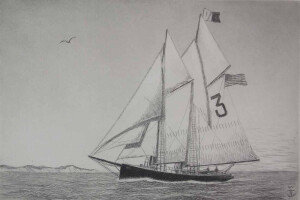 | NOTES: Charles J. A. Wilson was born in 1880 in Glasgow, Scotland. He came to America as an infant and in his teens moved to Newton, Massachusetts. Wilson was a prolific, self-taught, marine artist who gained much of his experience from working in the Boston shipyards. He worked as an artist for Bethlehem Shipbuilding in East Boston, etching their ships from blueprints. During the World War I, Wilson spent two years in France. After the war he was commissioned to paint and etch American ships and marine views. During World War II, Wilson worked in Boston as an official Coast Guard artist. He was a member of the Boston Society of Printmakers, and exhibited with Pennsylvania Academy of the Fine Arts, Society of American Etchers and the Currier Gallery. VESSEL INFORMATION - VESSEL NAME: D.J. LAWLOR VESSEL TYPE: BOSTON PILOT BOAT VESSEL DATE: 1882 SHIP BUILDER: PORTER KEEN SHIPBUILDER LOCATION: NORTH WEYMOUTH, MASSACHUSETTS VESSEL DIMENSIONS: 75 tons, 86 x 22 x 9.8 REGISTERED: BOSTON, MASSACHUSETTS FATES: Rammed and sunk by the fishing schooner Horace B. Parker in a storm and fog on January 5, 1895. SHIP OWNERS: HYDEN, REID, ABBOTT & O. (REC. 1880) VESSEL HISTORY: Listed for the last time in MVUS 1894 while registered in Boston Notes from Pilots and pilot boats of Boston Harbor : presenting stories and illustrations ...by Ralph M. Eastman, page 51: The Lawlor was built in 1882 by Porter Keene at Weymouth, Massachusetts, and was considered the best heavy weather boat in the service. She was named for Dennison J. Lawlor, the famous pilot boat designer. During a violent “northwester” early in the morning of January 5, 1895, in a dense fog, the Lawlor was rammed and sunk by the fishing schooner Horace B. Parker of Gloucester, Captain Thomas, about two miles off Minot’s Light, Cohasset. Having been “manned out,” the Lawlor was returning to port in charge of #1 Boatman Albert Laurine with three other apprentices and the cook, Rudolph Harrison, when the accident occurred. Harrison jumped from the bowsprit of the Lawlor to the deck of the fisherman. When Laurine tried to follow the bowsprit broke and he fell into the raging sea. The crew of the Parker did all in their power to save him and the three others on the Lawlor but all the lifesaving apparatus, ropes and lifeboats were covered with a foot of ice and could not be used. The Lawlor was owned in part by Captain William W. Abbott and his associate Pilot Captains John Leary, William W. McPhee and William Fairfield, all of whom providentially escaped the disaster as they had been put aboard inbound vessels to pilot them into Boston. | CL17256 | |||||||
| 23 | No image URL. | SHORT DESCRIPTION: Chromolithograph, plate XI, of Frederic Schiller Cozzens and J.D. Jerrold Kelley's 'American Yachts: Their Clubs and Races' published by Charles Scribner's Sons. Titled 'Minot's Ledge Light' showing yachts Fortuna, Tempest, Viva and White Cap. NOTES: LP 200- LP 225 are part of a set of lithographs in colors on wove paper by Frederic Schiller Cozzens (American, 1846-1928). Cozzens and Lt. J.D. Jerrold Kelley collaborated on the book 'American Yachts: Their Clubs and Races.' Between 1883 and 1884 Cozzens worked on watercolors of yachts and their marine settings which were turned into a folio suite of chromolithographs to accompany text written by Kelley. | CL18643 | |||||||
| 24 |  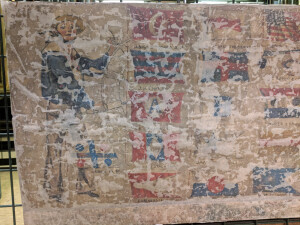 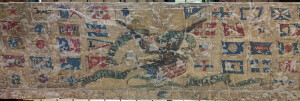 | SHORT DESCRIPTION: Oil painted board covered with white canvas. Sailors stand at either end of the board each holding the spokes of a large steering wheel. There is a large eagle with wings spread over a United States shield. A banner in his beak reads "Private Signals of the Merchants of Boston, Mass. NOTES: Before the advent of the electric telegraph, a system of flag signals was in use, the merchants of Boston having a set of one hundred and twelve private signals, each one a different flag. When a ship arrived, the owner's color was run up at Hull, repeated on an island in the harbor, again shown on Central Wharf, and finally at the old State House. NOTES: The painting appears to be severely overpainted as some of the merchants names are spelled incorrectly. There are photographs in the object file which seem to show the painting undergoing some sort of "restoration" in the shipyard's model shop in the 1930s or 1940s. The painting was faced with tissue and varnish in the 1970s to try and hold the painted surface together. It has remained that way ever since. This may be the original painting from which the well-known lithograph by Kramer & Co. was created from. There are some mistakes in the rendering of the signal flags that may be attributed to the heavy overpaint. For example: in column 7 a rectangular flag with a yellow field and blue dot has no name underneath (T. S. Davis & Co.) and in column 8 the Higgins & Co. flag is portrayed as a rectangular shape with white field and blue dot when its supposed to show a swallowtail shape with white field and blue dot. NOTES: For references below see object file. Iasici, Goddard, & Co. is also spelled Iasigi or Jasigi. The partners were Joseph Jasigi and Thomas A. Goddard. From Joseph’s 1897 obituary, he came to Boston from Armenia in 1830 and formed the partnership. His son, Joseph Andrew Jasigi, was born in 1848 and eventually became a partner. Joseph Andrew went on to be a consul general to Turkey but was arrested for embezzling $220,000, for which he spent 12 years in prison. J. H. Cheney operated in the 1840s and 1850s as a merchant and ship broker. By 1855 he had offices at 4 India wharf. Larkin & Stackpole Co. - Charles Larkin and David D. Stackpole (1811-1879) started the company in 1852 and continued until 1877 when it became Larkin & Cutting with Andrew Cutting. F. Nickerson & Co was Fred W. Nickerson (1808-1879), the company name became F.W. Nickerson & Co. after Fred died. F.W. Nickerson included Frederick W. Nickerson, Alfred A. Nickerson, and Elkanan C. Crosby but their company failed in 1886 after their ship, City of Columbus, sank. Blanchard, Sherman & Co. included Alfred Blanchard, Elisha Sherman, and George Baker. They were in business as commission merchants from the 1840s to mid-1860s. Sampson & Tappan were George R. Sampson and Lewis W. Tappan. They were co-owners of the Stag Hound with George B. Upton, which was an extreme clipper built by Donald MacKay. One of their New York representatives was Vernon H. Brown who later worked for Cunard Steam Ship Company. One of the largest shipowners in Boston. N. & B. Goddard - Nathaniel Goddard had an office at 24 Union wharf in 1836 but failed before Panic of 1857. W. M. Ropes & Co. - William H. Ropes and Joseph S. Ropes had offices at 36 India wharf 1848. They had relocated to 25 Lewis wharf by 1855 but by then the partners were William H. Hardy and Joseph S. Ropes. The company was still in business there in 1862 with William Ropes, Hardy Ropes, and Joseph S. Ropes as partners. Homer & Sprague - Richard T. Sprague and Charles Homer appear in the papers as early as 1843. They had offices at 36 India wharf by 1855 and were still there by 1872. Page, Richardson & Co. dissolved in 1875. Dabney & Cunningham - Frederic Cunningham (1826-1864) and his cousin, Charles William Dabney, Jr. started the company in 1848 but closed when Cunningham died. Their offices were at 59 Commercial wharf and they owned the ships Harbinger, Pomona, Grampus, Melita, Io, Mermaid, Lotos, Azor, and Fredonia. A. Cunningham & Sons started in 1822 as A. & C. Cunningham (Andrew & Charles) but Charles retired in 1849 so Andrew's sons, James Henry Cunningham and Charles West Cunningham became partners and the name changed to A. Cunningham & Sons. Charles' son, Frederick, helped start Dabney & Cunningham above. Crowell, Lewis & Co. was Joseph D. Crowell, William H. Lewis, and George T. Lovell. They were ship chandlers at 120 Commercial wharf in 1852, and also appear in the 1872 city directory. Zadoc C. Crowell was a senior partner when he died in 1887. E. Atkins was Elisha Atkins, he started working with William F. Freeman in 1838 as Atkins & Freeman, but went into business alone in 1849 until 1866 when John W. Cummings became a partner and the company became Atkins & Co. Elisha died in 1888 but Atkins' son and grandson eventually joined the company as late as 1915. Baker & Morrill was Ezra H. Baker and Charles J. Morrill. The company started in 1840s as Baker & Hardy with Alpheus Hardy. When Morrill worked his way up from bookkeeper to partner in 1845 the name changed to Hardy, Baker, & Morrill. When Hardy retired the name became Baker & Morrill. They owned the ship Southern Cross, built in 1851. Daniel Draper & Son - Daniel (1788-1867), by 1855 William Perkins Draper was in control with offices at 20 S. Market. A.C. Hersey was Alfred C. Hersey (1804-1888), a merchant at 67 Commercial wharf by 1855. His obituary states, he "was the largest owner and wharfinger of Commercial wharf for 25 years,” and he was also a partial owner in at least 40 different vessels. Charles S. Brown & Co. were commercial merchants at 11 Custom House Street in 1855 city directory. By 1857 and again in 1858 they are at 28 India Wharf. Geo. M. Barnard was George M. Barnard, who appears in the papers as early as the 1840s. He had offices at 41 Commercial wharf by 1855, and in 1866 contributed money toward the purchase of a school ship, it was sold in 1872. John H. Foster & Co. were grain merchants but the company was suspended in 1880. Howes & Crowell - Osborn Howes was born in 1806, started the company with his brother-in-law, the company lasted 34 years. Ships included the Josephine, George Hallett, Newton, and Osborn Howes. 1855 city directory has Osborn Howes and Nathan Crowell as commercial merchants at 65 Commercial wharf. J. H. Shattuck & Co. - Alfred B. Warren, Francis A. Osborn were ship chandlers at 4 Commercial Wharf in 1855 city directory. Warren died in 1881. Matthew Cobb appears in the papers in the early 1840s. By 1855 he had offices at 4 Central wharf, and in 1858 a ship he owned, Serampore, was lost off Cohasset in a snow storm but all hands survived. Henry Gardner (1809-1890) was a merchant in the 1830s and 1840s who owned the ship Hazard, bark Henry, and schooner Renown, and others. Sprague, Soule & Co. - They sold plaster as early as 1839, and by 1848 the partners were William Sprague, George M. Soule, and Edward Whitney with offices at 7 T wharf. By 1855 the partners were George M. Soule, Edward Whitney, and Alfred Winsor, dealers in plaster and grindstones. They helped start what became the Boston & Philadelphia Steamship Company, running it under their name until 1873. Henry Winsor died in 1889 and Alfred Winsor became president. Tow Boat R. B. Forbes was named for Captain Robert Bennet Forbes. The tug was built in 1845 by Otis Tufts, the first with an iron hull to be built in Boston. It helped ships move from the New England shipyards to New York to finish the fitting out process and was sold several times until the U.S. Navy purchased her in 1861. She ran aground in a storm off Cape Henry on February 25, 1862, and was lost. Perrin & Gilbert – Franklin Perrin and Benjamin W. Gilbert were commission merchants at 49 Central Wharf in 1855 city directory. H. P. Oxnard – Henry P. Oxnard was a merchant at 19 India in 1855 city directory Crowell, Brooks & Co. – Henry G. Crowell and H.C. Brooks with S.M. Hunt at 37 and 38 Commercial Wharf in 1855 city directory. George B. Upton born in 1804, was shipowner, ship designer, and politician. Listed as merchant in 1855 city directory at City Exchange and a house at 56 Bowdoin. Involved in shipping, whaling, railroads, died in July 1874. Prince & Baker – Richard M. Baker and Samuel Prince were sailmakers at 22 India Wharf in 1855 city directory David Snow & Co. were commercial merchants. In 1853 they owned the ship Reporter, by 1855 they had offices at 1 Commerce, and in 1874 when Otis wharf caught fire their fish wharf burned as well. G. T. & W. P. Lyman - George Theodore Lyman and William Pratt Lyman were merchants at 97 State Street. The company failed in Panic of 1857. J. S. Coolidge & Co. - Joseph S. Coolidge worked with George H. MacKay from 1833-1850, then started his own firm. The partners were John Templeton Coolidge, Joseph S. Coolidge, Jr., and John Templeton Coolidge, Jr. They owned ship Nor’wester in 1855, also owned Versailles, Atlas, Annie Buckram, and R.B. Forbes. By 1855 the partners were A.C. Slater and John Templeton Coolidge, Jr. Seccomb & Taylor started as Seccomb, Bartlett, & Co. who were commission merchants at 31 and 32 Commercial wharf in 1845; the partners then were E. Seccomb, C.L. Bartlett, and E.R. Seccomb. By 1852 the company had become Seccomb & Taylor, with Captain Isaac Taylor involved. They built ships and sold them rather than operating the ships themselves. The company owned the Winged Racer, Swallow, Queen of Clippers, Red Jacket, Blue Jacket, and Springbok. By the 1870s Charles L. Bartlett ran a firm called C.L. Bartlett & Co., but whether it was the same company or something separate is unknown. He died in 1883. Hill, Sears & Co. - Hamilton A. Hill and Eben Sears were commission and forwarding merchants at 21 Commercial wharf in 1855 directory. They were taxed in 1856, by 1857 they were at 69 Commercial Wharf. A large fire in 1851 destroyed their paint stuffs. B. C. Clark & Co. - Benjamin C. Clark & Co. operated from 1830-1848, owned Sea Eagle, Water Witch, Silenus, Red Rover, Sea Mew, he built and owned schooner Mermaid the first decked yacht in Boston, and built Raven which won the first regatta cup sailed in Massachusetts Bay in 1845. Fisher & Co. Eben S. Fisher, Francis Fisher, Francis K. Fisher, and J.B. Robinson were commercial merchants at 23 Central Wharf in 1855 directory. By 1866 directory the firm was Eben S. Fisher, Edward P. Fisher, Emery P. Fisher, Francis Fisher, Francis K. Fisher, John H. Fisher were commercial merchants at 23 Central Wharf. E. D. Brigham & Co. - Elijah D. Brigham & Co. existed by 1846 with offices at 1 Long wharf with Joseph L. Brigham. By 1855 the partners were J.S. Brigham and Joseph L. Brigham, but the company (flour merchants) failed in the Panic of 1857. An 1859 advertisement has J.S. Brigham working with Thayer, Brigham, & Field and next to Brigham's name is (late E.D. Brigham & Co.). Vernon Brown & Son (see Sampson & Tappan above) - shipbrokers at 5 Merchant Exchange. Vernon H. Brown became the agent for Cunard Steam Ship Line. Wm. Appleton & Co. - William Appleton started the company and Samuel Hooper joined him in 1842. Samuel Hooper, F. Gordon Dexter, John H. Reed were merchants with this company at 35 and 36 Lewis Wharf in 1848 and still in 1855. They were part owners of the Ocean Monarch with Enoch Train & Co. and R.G. Shaw & Co. Wheelwright & Cobb – Josiah Wheelwright and Samuel C. Cobb in 1855 directory as commission merchants at 47 Central Wharf W. A. Harris – William A. Harris was a merchant and agent at 7 Rowe’s wharf in 1855 directory Isaac Rich & Co. - Isaac Rich (1801-1872) was in the fish business and one of the founders of Boston University. By 1855 the partners were Aaron B. Vannevar, Orien E. Downing, Thomas A. Rich, Edward S. Dane at 35 Commercial. The company was at the same address in 1872, but by 1889 they were in debt and hoping for an extension on the repayments. Thomas A. Rich had been in the fish business since at least 1849. B. Burgess & Sons appears in the newspapers from 1840-1881. Benjamin Burgess, Nathan B. Gibbs and Benjamin F. Burgess were commission merchants at 38 India Wharf, but the company failed in 1881. Chas. B. Fessenden is in the papers in 1842, was a commission merchant at 134 State in 1855 directory. The 1879 directory has him working as part of Fessenden, Russell, & Co. Williams & Daland – Henry T. Daland and Henry L. Williams were merchants at 33 Lewis Wharf in 1855 directory. Firm dissolved in 1862. Trull Brothers were distillers Ezra Trull and John P. Tarbell, they had a fire in 1838 when the vapors from the liquor caught fire. They existed at 50 Merrimac between 1851 and 1855. By 1859 they added Alexander Sidi to the firm and offices had moved to 42 Court. There was another fire in 1857 and the company failed in 1858 but Daniel Emery Chase (who had started working there in 1852) took over for the year until he partnered with Ezra Trull & Co. to eventually become Chase & Trull by late 1860s or early 1870s. Pierce & Bacon - George Bacon, Thomas Pierce partnered in 1845, grocers who began trading. In 1851 they partnered with Andrew Pierce and he joined in 1852. Dissolved in 1865. Magoun & Son - Thatcher Magoun and Thatcher Magoun Jr. were merchants at 66 State in the 1855 directory. Magoun started the company in 1833, but when he died in 1856 at age 81 his son and grandson carried on with same company name until dissolved in 1877. They had more than 60 ships at one time. He was a ship designer, builder, and merchant and built many of his own ships. W. & F.H. Whittmore & Co. - sometimes spelled Whitmore Alpheus Hardy & Co. - Alpheus Hardy and Ezra Baker worked together in the 1840s along the coast then extended to the Mediterranean. Never lost a ship to the Confederates in the Civil War. Hardy died in 1887 so his son, Alpheus H. Hardy, took over. Thomas Lamb - President of New England National Bank of Boston, daughter was Emily Goddard Lamb who married Gustavus Tuckerman, Jr. in 1851 (see Tuckerman, Townsend & Co. below). E. Gassett & Co. - Edward Gassett & Co. were merchants at 67 Commercial Wharf with Edward R. Hall in 1855 directory. Owned clipper ship Mermaid. Lombard & Co. - Ephraim Lombard was a commission merchant who started the company in 1827 and operated from 13 Lewis wharf by 1838, by 1851 they were running packets to Charleston, SC. They were the original co-owners of ships Moneynick (1854), Edisto (1851), and Seabird (1851). The company was still in existence when his son, Ephraim Lombard, Jr. died in 1916 but the offices had moved to South Boston by that year. R.C. MacKay is Robert Caldwell MacKay, a ship owner who worked with J.S. Coolidge between 1833 and 1850 at 16 Union wharf, and continued his offices there through the mid 1850s. He owned property on Beacon Street. A.S. & W.C. Lewis - Should be A.S. & W.G. Lewis for Abiel Smith Lewis and William Gustavus Lewis. They were commission merchants at 53 Commercial wharf. They possibly worked as druggists for a time in the 1840s, but by 1872 the company operated from 7 Rowes Wharf with Charles Dudley Lewis. Enoch Train & Co. – Train Line (White Diamond Line) of packets to Liverpool started in 1844, Enoch worked with his uncle Samuel Train earlier. Located at 37 Lewis Wharf, then around 1852 he bought Constitution Wharf with his private offices on State Street. After he died in 1868 the company became Thayer & Warren, then Warren & Co. Glidden & Williams began in 1849 with William T. Glidden and John M.S. Williams; by 1852 John A. Glidden had become a partner and the company had started a line of packets to San Francisco. They were merchants at 29 Lewis wharf by 1855 but the company dissolved in 1877. Possibly related to the current Glidden paint company. Rush & Wildes - should be Bush & Wildes. Moses B. Wildes and James P. Bush were commission merchants at 20 India Wharf in 1855 directory and owned the ship Whistler. They appear in books in 1837 and again in 1860. Later the company may have become Bush & Comstock. Curtis & Peabody - Francis Curtis and S. Endicott Peabody were merchants at 40 India Wharf in 1855 directory. Suffered during panic of 1857 but appear in directory of 1870 at 40 State. E. Weston & Son was Ezra Weston who started the company E. Weston in 1763. His son, Ezra Weston II became a partner in 1798 and the name became E. Weston & Son, then full owner when his father passed away in 1822 and the name returned to E. Weston. Ezra Weston II's sons took over the company when he died in 1842 and the name became E. Weston & Sons. The sons were Gershom Bradford Weston, Alden Bradford Weston, and Ezra Weston IV. Their offices were on Commercial wharf, but the company closed in 1857. John M. Mayor & Co. - should be John M. Mayo & Co. were merchants at 5 India Wharf in 1855 directory. Crocker & Sturgis - James Sturgis and Henry H. Crocker were merchants at 80 State in the 1855 city directory, but had worked with Crocker & Warren of New York since the 1840s. Reed & Wade - Reuben S. Wade and Samuel G. Reed, appear in papers by 1846 and then merchants at 16 North Market in 1855 directory. Owned steamer Argo at one time. A. T. Hall - Andrew T. Hall, died November 1875 from obituary in The Boston Globe, 23 November 1875: He was 77, worked with brother Samuel and John T. Wells in company, became largest importers of crockery and glassware in the country. Firm dissolved in 1847, owned ships, supported Enoch Train’s “famous line of packets.” George C. Lord was born in Kennebunk, Maine in 1823 and moved to Boston in 1843. He formed the company in 1850 with his brother and they became ship builders and owners. They launched ship Josephus in 1850 from Kennebunk, and later owned bark Wild Hunter that was dismasted while at sea in 1882. Charles H. Lord was listed as a partner in 1855 and George C. Lord died in 1893. Bush & Comstock were agents for Pacific Mail Steamship Company in 1862. S. C. Thwing & Co. - 1877 obituary says Supply C. Thwing was born 1798 and died 1877, formed partnership in 1831 with Stephen H. Perkins, Perkins retired in 1844 so Thwing partnered a few days later with Richard Sullivan to form S.C. Thwing & Co. Sullivan retired in 1867 when E.B. Townsend and John Thomas joined the partnership. They were merchants who owned vessels, worked in coal trade. T. B. Wales & Co. - The 1832 city directory has the company as a partnership between Nathaniel H. Emmons and Thomas B. Wales Jr. at Wales wharf. From Emmons’ 1878 obituary, he joined the company as a boy in the counting room and worked his way up to become a partner. He married a Wales daughter. By 1855 George W. Wales had joined Emmons as a partner at 50 Central wharf. Cunningham Bro’s started by two nephews of Andrew and Charles Cunningham (see above), John A. Cunningham and Loring Cunningham Tuckerman, Townsend & Co. - Gustavus Tuckerman Jr. was born in England in 1824. He represented Curtis & Greenough and made partner after 1849. He married Emily Goddard Lamb, daughter of Thomas Lamb (see above), in 1851. Around then Alfred Greenough died so Tuckerman Jr. partnered with Thomas D. Townsend to create the firm. Company dissolved in 1859 because of bad trading economy with India. N. Winsor Junr & C. - Nathaniel Winsor Jr. & Co. was run by Aaron Sargent Jr, a commercial merchant in 1855 directory. | CL12612 |
Created 2026 by Don Barker, CBMM volunteer, for the Chesapeake Shipbuilding Project. shipbuilding@sailingworkboats.es